
CHEAP DOPAMINE
Have you ever noticed that soft drinks in Vietnam and other Southeast Asian countries are often sweeter than in developed countries like Singapore, Taiwan, Korea, Japan, Canada, etc.?
More than 20 years ago, my parents ran a small convenience store when I was in elementary school; they closed it by middle school because I... 'consumed' too much of the inventory. Besides eating snacks, every midday I would ask my parents for a bottle of Number 1 energy drink, regular as clockwork.
By coincidence, my in-laws also run a convenience store. I spent a short time there helping out, and soft drinks and beer were the two things I sold the most. For soft drinks, the top seller was Sting (red), followed by Red Bull, and then all other carbonated drinks.
Who are the buyers?
Surprisingly, after 20 years, the buyers are still kids like I was, up to young adults, whom I'd estimate and observe to be in the low-income bracket—what you often see in a brief as the 'mass segment.'
I don't have the growth reports for these brands, but I'd guess they're still selling well amidst all those reports on young people's healthy eating trends, hehe.
So why does this segment buy so much?
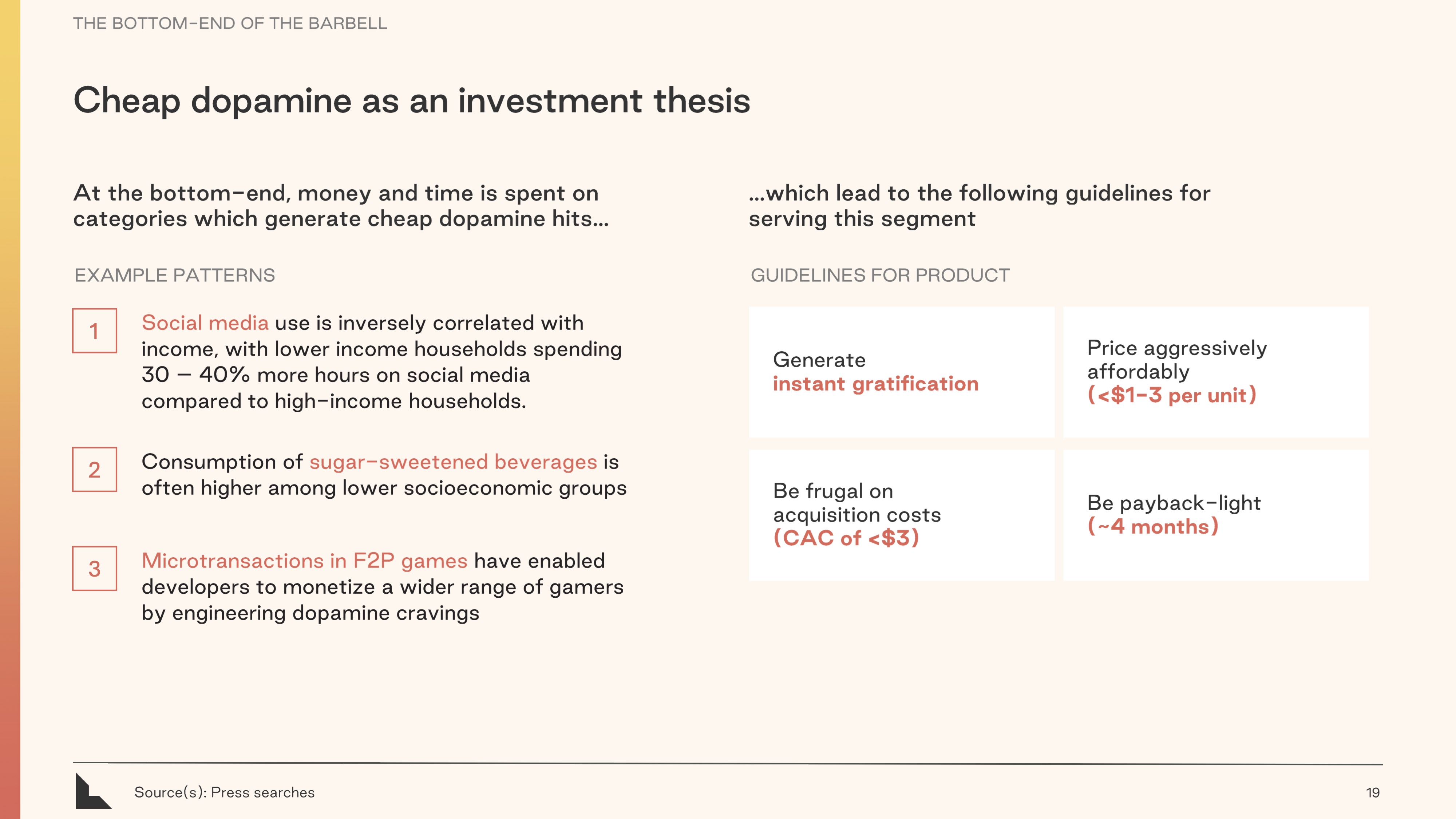
Because they need cheap dopamine. Cheap dopamine = simple, easily accessible activities or habits that provide a quick, but often short-term, feeling of pleasure, such as scrolling social media, eating sweets, or playing games.
If you've read my previous article about the discretionary spending of the middle class, for the mass segment, they pay for cheap dopamine because that's all they can afford to pay for pleasure.
Companies and brands know that in developing markets like Vietnam and Southeast Asia, the discretionary spending of the mass segment is still low, making this a fertile ground for selling cheap dopamine.
The investment fund Lightspeed even made their Investment Thesis: invest in startups that can create cheap dopamine. They're not wrong, they're just too ignorant.
Aside from the soft drink example above, I also sold 2 cans of beer every day to a motorbike taxi driver, regardless of whether he had customers that day or not. In gaming, Axie Infinity was highly successful in creating the largest play-to-earn community in the Philippines among low-income earners. There are many other games where I suspect the VIP purchasers mostly belong to this group. Or, on Threads city, whether intentional or not, it seems to be mostly about expose posts?
That's the reality, but where there is demand, there is supply. When the needs change, brands will have to adapt, it's just a matter of time.
As for those of us in marketing, media, and advertising, let's at least do no harm when working with brands that sell cheap dopamine—don't harm anyone with our communication. I often share this 'principle' with my students because some brands have done terrible things, but those who know, know.
Now, I pray that after 20 years, all that sugar has been flushed out so I can teach for at least 20 more courses.