
Recently, at least three of my friends discussed launching a course with me, and then there was the drama from the student community of a famous stock investment course.
As someone who has run a course for over two years, I want to share a few thoughts with those who want to launch a course and those who are considering which course to take.
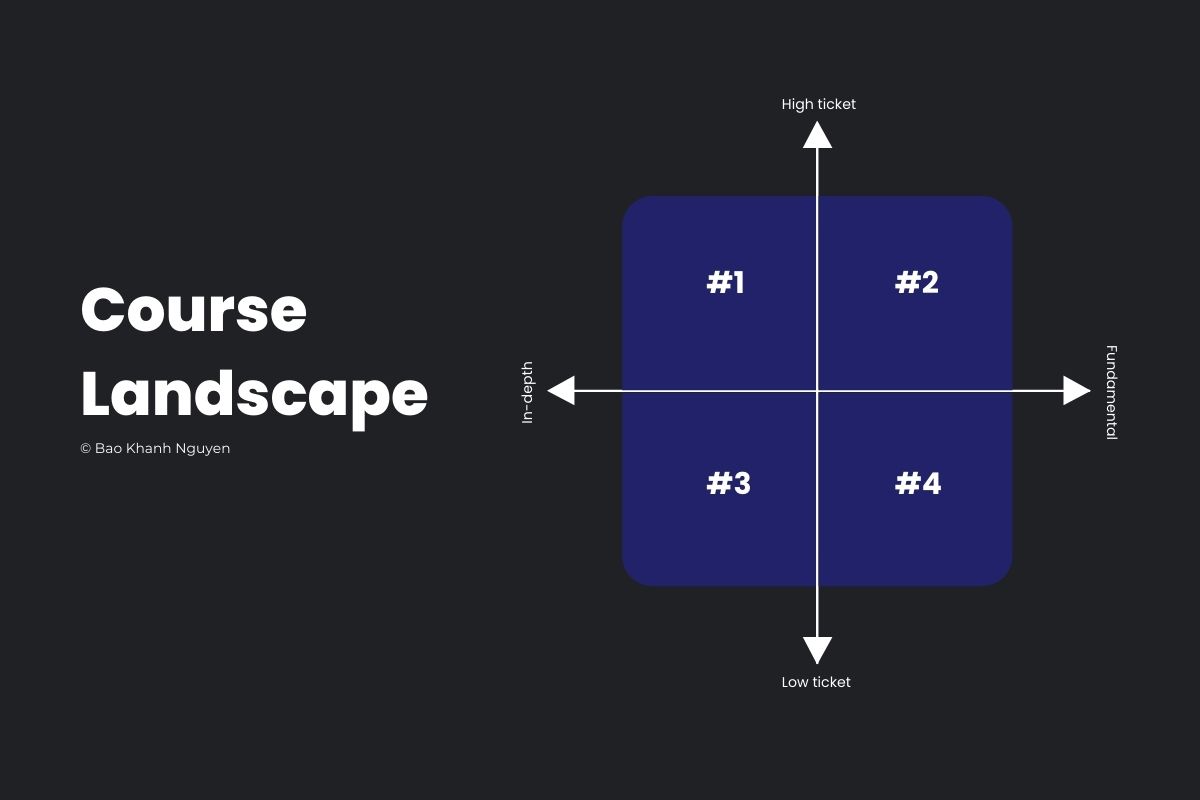
Below is a VERY BASIC course positioning model based on two parameters: (1) tuition fee (ticket) and (2) depth, divided into 4 quadrants.
Quadrant #1: In-depth & High ticket
- Content: Must be specific, in-depth, high-quality, and nearly impossible to Google or ask ChatGPT for.
- Instructor: Must have high expertise, a good and verifiable reputation (through recommendations, feedback, reviews), solid knowledge, and clearly understand the limits of what they can and cannot teach.
- Learning Experience: Small, very small, or even 1-on-1 class, high interaction, extensive discussion, and high personalization.
- Who should enroll: Individuals who are already learning/working in the related field and need to upgrade their knowledge/skills for career and life development.
Quadrant #3: In-depth & Low ticket
Similar to Quadrant #1, with the following differences:
- Instructor: The business purpose is lower; the instructor wants to give back/pay it forward or is sponsored to teach. The profiles of these individuals might even be more impressive than those in #1.
- Learning Experience: Not everyone gets the opportunity to enroll.
- Example: In 2018, I attended a 2-week Tech Startup Ecosystem Building course in Israel, and I was fully sponsored; I only had to pay for my airfare (which I consider the "low ticket" I paid). In 2019, I attended a free Business Leadership course organized by a successful corporate co-founder in Vietnam. The common thread for both courses is that I had to be invited or apply to attend.
Quadrant #4: Fundamental & Low ticket
- Content: Fundamental, can be self-taught (but difficult to know where to start without guidance).
- Instructor: A credible individual with expertise, but a vast amount of experience is not necessarily required.
- Learning Experience: Standardized knowledge, low personalization.
- Who should enroll: Anyone who wants to explore a completely new field, wants to learn quickly while saving time, or simply wants to know more.
Quadrant #2: Fundamental & High ticket
To me, courses in this quadrant are sketchy, and I believe the market for these courses didn't exist initially, but someone saw the opportunity to "scam" people (Courses to run ads for sales, courses to get rich, investment courses with guaranteed profit,... and many other keywords you can comment below...). This is the reason why genuine course creators get a bad rap.
- Content: Basic, can be easily Googled or asked to ChatGPT, but presented to look more appealing and dangerous.
- Instructor: Profiles are often exaggerated with unverified details, they have excellent public speaking skills, talk more about principles than knowledge, and are skilled at manipulation to charge high tuition fees.
- Learning Experience: Very... hyped-up, fake it till you make it, classes are large to very large, and everyone leaves thinking they will never fail.
- Who should enroll: People who like to get rich quick, become smart quick, or achieve success quickly.
I hope this long-winded explanation helps those who want to launch a course choose the right positioning and feel confident to open one once they've lived long enough 🫰
And for those of you who want to enroll in a course, choose wisely (but sometimes, if you choose wrong, you can choose again, don't stress too much 😂)